

Your stakeholders ask what competitors are doing. You open a dozen tabs, save a few screenshots, and promise a deck by Friday. Two weeks later the deck is stale and nobody remembers which ad matched which landing page.
Good competitor research for marketing is repeatable. It pulls from public sources you are allowed to use, stays organised, and sits next to what buyers actually say. This article walks through what to capture, where to find it, and how to use it without turning your week into manual archaeology.
What "competitor research" should include
At minimum you want three layers: live ad creative and copy, where those ads send traffic, and how competitors describe themselves on key site pages (home, category, pricing, lead capture). Optional but valuable: search ad themes where transparency tools exist, social proof they highlight, and offers or guarantees they repeat.
You are not trying to copy them. You are building a shared picture of the promises and angles the market sees every day. That picture is what creative, growth, and leadership align on before you write your next line.
Public sources marketers actually use
Meta’s Ad Library shows active and historical ads across Meta technologies for pages you identify. Google’s ad transparency surfaces many formats competitors run in supported regions. Both are built for disclosure, not stealth: use them as intended and respect each platform’s terms.
For site positioning, you read the pages prospects hit after the click. Headlines, subheads, proof blocks, and CTAs tell you how they finish the story the ad started. If you only save the ad and skip the destination, you miss half the narrative.
Stay inside public, allowed sources
Stick to information competitors have chosen to show publicly: ad libraries, their websites, app store listings, and press they issued. Do not misrepresent login-gated areas, private groups, or confidential material. Ethical competitor research protects your brand and keeps findings usable in front of legal or leadership.
Why screenshots alone break down
Folders of PNGs do not scale. Names like "ad_v3_final" do not help six months later. Teams lose the link between creative, URL, and date seen. When someone asks "which competitor ran that guarantee," nobody can answer quickly.
A workable system keeps competitor entities (brands or domains), timestamps, creative or copy snippets, and destination URLs in one place. Whether that is a database, a structured doc, or software built for competitor runs, the goal is the same: searchable, attributable, and easy to brief from.
Pair competitor view with customer language
Rivals show you what the feed looks like. They do not tell you whether buyers believe those claims or which phrases people use when they complain. Your strongest angle often sits in the gap between competitor promises and what customers actually say in public conversations.
When you can place "they all say X" next to "our research shows buyers care about Y," you give copy and design a rationale that holds up in review. That pairing is the difference between me-too messaging and a differentiated brief.
Turning research into briefs and tests
Start from observed patterns: repeated hooks, shared objections they pre-empt, price or risk framing, and visual tropes. Note what is crowded so you can deliberately avoid or counter it. Pull two or three concrete examples per point so creatives see real references, not abstract bullets.
Feed those patterns into channel work. For paid social, see how ad copy fits into a broader workflow once you know what the market is already hearing. For landing pages, compare competitor on-page promises to the themes you approved from customer research before you lock structure.
Cadence: one-off vs ongoing
Quarterly deep dives help planning. Monthly or sprint-based checks catch new creatives and seasonal pushes. If you run always-on acquisition, your competitor snapshot should update often enough that media and creative are not briefing off last quarter’s feed.
Document who owns updates, which competitors are in scope, and which markets matter. Ambiguity is how research drifts. Clear ownership keeps the habit alive.
How WeThryv fits this workflow
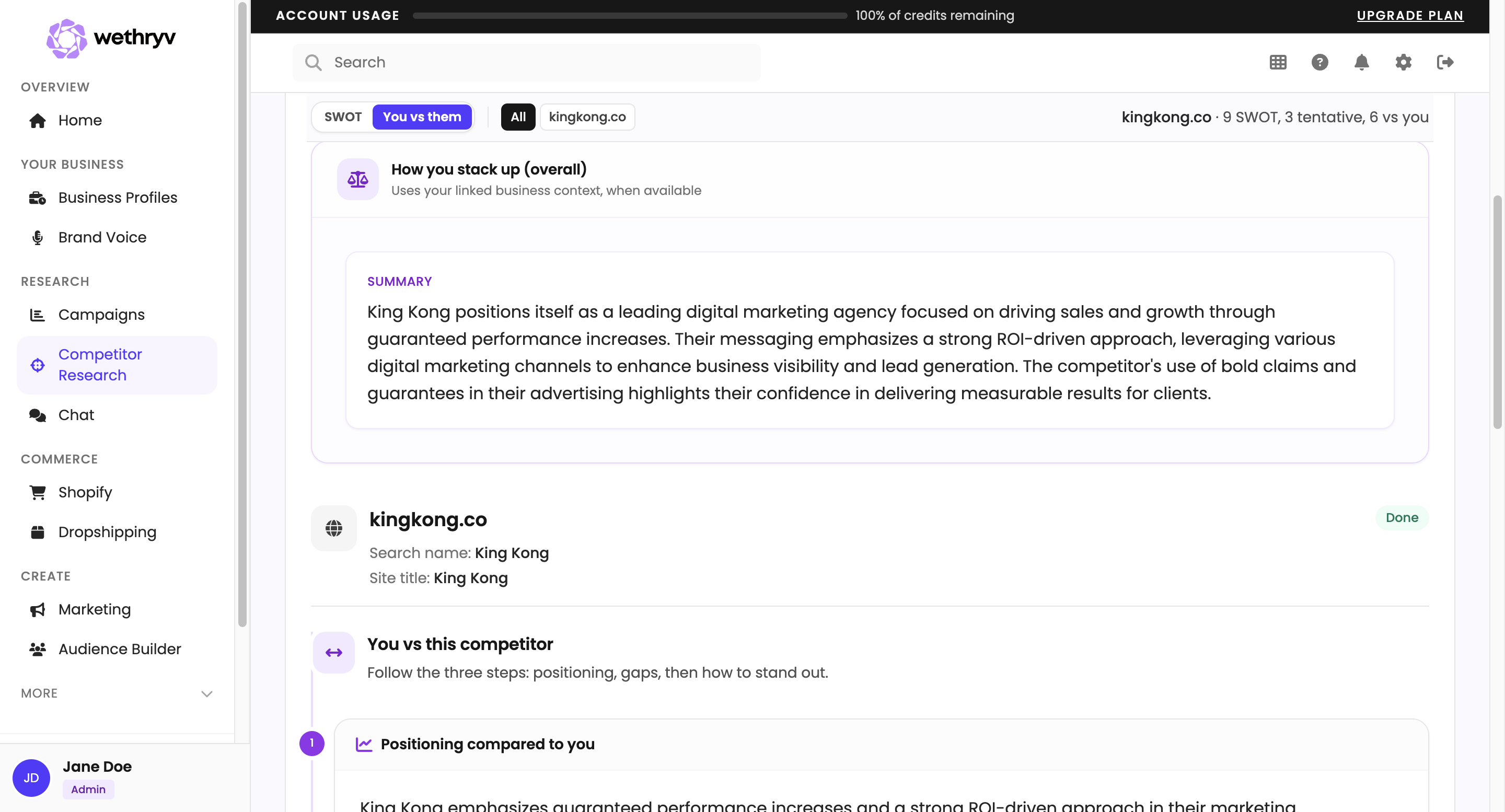
WeThryv’s competitor research collects public Meta and Google ad signals plus relevant site positioning, then lines that up with your business profile, brand voice, and campaign insights. The intent is a single workspace where "what they run" and "what we know about buyers" can be compared without retyping everything into slides.
If you are evaluating plans, pricing shows which tiers include competitor runs alongside insight and copy tools. For the full product flow, see how it works.
Mistakes teams make
Treating competitor research as a single PDF that never updates. Comparing your aspirational positioning to their oldest ads. Ignoring small regional players who still shape price and promise perception. Forgetting to log the date and market for each capture, so nobody trusts the file. Fixing these habits costs little and saves arguments later.
Which source answers which question
Teams mix ad libraries, homepages, and third-party reviews into one pile. That blurs what you are allowed to claim in a brief. Separate artefacts by job: some show positioning intent, some show delivery reality, some show buyer language after the fact.
| Source | Best for | Watch out |
|---|---|---|
| Meta / Google ad libraries | Hooks, offers in market, creative fatigue patterns | Creative may target a segment you do not sell to |
| Competitor site and pricing pages | Packaging, proof claims, onboarding promises | Often aspirational; compare to reviews and support themes |
| SEO / content hubs | Topic ownership and education bets | Long sales cycle; not always what paid social is testing |
| Public reviews and forums | Gap between promise and experience | Noisy; look for repeated phrases, not one-off rants |
Legal hygiene: Competitor research belongs in internal briefs. Do not copy their lines or imply endorsement. Use patterns to decide what to avoid, counter, or own—not to mimic.
For evidence-led messaging next to this stack, see evidence vs guesswork on audience and evidence-based marketing and conversion.
Bottom line
Competitor research for marketing works when it is structured, sourced from public tools, and connected to customer evidence. Tabs and screenshots are a starting point, not the system. Build a process your team can rerun, brief from, and defend when someone asks why your angle is different.